Travelling with a wheelchair, not a Santa Sleigh: Exploring Frankfurt’s Accessible Tourism in the Christmas Season
- Yau Yau

- Dec 27, 2023
- 11 min read
By Carmen Yau & Jochen Popp*
*This article shares the tourist experience of the first author as a disability advocate. The second author is acknowledged for his contribution to the research, support and authorship of the journey to the Frankfurt Christmas Market.

This year, I am eager to explore Christmas in European cities. Visiting Frankfurt Christmas Market is on my bucket list. I am a regular visitor of Frankfurt as I visit this beautiful place twice a year in average. I am eager to see and truly appreciate Frankfurt in a whole new light at Christmas. Frankfurt Christmas market is a sought-after winter destination in all of Europe. Frankfurt Christmas market earns a glittering name-recognition not only because of the gingerbread-scented scenes, belly-busting treats and hot mulled beverages, it is one the oldest and largest Christmas markets in Germany, with a document that traces its roots to 1393. With its whimsical and historical background, I love seeing old sights juxtaposed with the new. Frankfurt is the chosen destination for my Christmas exploration as a significant milestone of my life as well as my research on accessible tourism.

Accessible Tourism in Christmas
As a disability advocate and researcher, I feel obligated to promote accessible tourism around the world. Accessible tourism entails the attitude and determination to be inclusive and accessible for people from all paths, life stages and (dis)ability. According to the World Health Organization (WHO, 2023), an estimated 1.3 billion people (approximately 16% of the global population) experience significant disability. Thus, about a third of the global population are indirectly affected by disability as they are significant others of people with disability, including spouse, children and carers.
In the light of the bloom of our aging population, accessibility for all is a prerequisite for tourism. Accessible tourism signifies equality for all in human rights and business opportunities. Based on The United Nations World Tourism Organization (UNWTO)’s prediction, tourism will increase steadily reaching 1.8 billion international tourists by 2030. Thus, according to the 2030 Agenda for Global Action containing the Sustainable Development Goals, Goal 11 focuses on principles to “Make cities and human settlements inclusive, safe, resilient and sustainable”. This implies cities and tourism provisions should entail concepts of universal design, inclusion and accessibility in their tourism and recreation infrastructure (e.g. transportation, and public spaces). However, accessible tourism is vastly under-served due to inaccessible travel infrastructure, discriminatory policies and poor practices. Therefore, the travel experience of people with disability helps to identify the barriers and suggest potential solutions for individuals with disability and stakeholders of the cultural tourism ecosystem.
In this article, I shared my experience and observation as a tourist with disability. Travelling with a wheelchair is complicated, and when you factor the festive season into the journey, you need something more than the Christmas spirit. You count on your determination, creativity for solutions, and adventurous spirit. I was exceptionally fortunate to have a personal assistant Jochen Popp (the second author), who was born and raised in Germany, to support me through the field trip to Frankfurt from 29th November 2023 to 5th December 2023.
Experiences in Christmas Markets
In this field trip at Frankfurt Main, we visited four different Christmas markets including the Weihnachtsmarkt Frankfurt Römerberg, Christmas stalls around Hauptwache, Rosa Weihnacht (aka, Frankfurt Pink Christmas Market) and Weinachtsmarkt im Thurn & Taxis Palais (aka, T&T Weinachtsmarkt).

Based on our experience and observations, there are three areas we would like to highlight:
First, the accessibility of routes and space. The size of Christmas markets varies. As the heart and soul of Frankfurt’s Christmas Market, the Römerberg square is a “come-to-life” snow globe with a glittering 30m Christmas tree topped with lights and red ribbons, two showy vintage carousels and countless stalls decorated as gingerbread houses. The Pink Christmas Market and the T&T Weinachtsmarkt are compact but picturesque. The Christmas stalls around Hauptwache is accessible and conveniently linked to Frankfurt’s busiest shopping street.
The main routes and entrances of these Christmas markets are wheelchair accessible and well-planned. Cable covers around the main routes had wheelchair ramp covers to ensure wheelchair users and pushchairs could explore around smoothly. However, these ramp
covers did not cover shortcut routes and some areas behind the scenes.

At one of the entrance of Pink Market, a wheelchair ramp was placed on the cable cover to ensure smooth and safe entry. Another wheelchair ramp was placed on the cable cover. These ramps were not only for wheelchair users, they helped to prevent the falling of visitors, especially when the market was overcrowded.
At the Weihnachtsmarkt Frankfurt Römerberg, we found the Mainkai area was not wheelchair accessible. There was a gate to block the transportation, but it also prevented wheelchairs from accessing the area. There were a few thick rubber carpets to cover the pedestrian step, but it was not designed and safe as a ramp for wheelchair users.
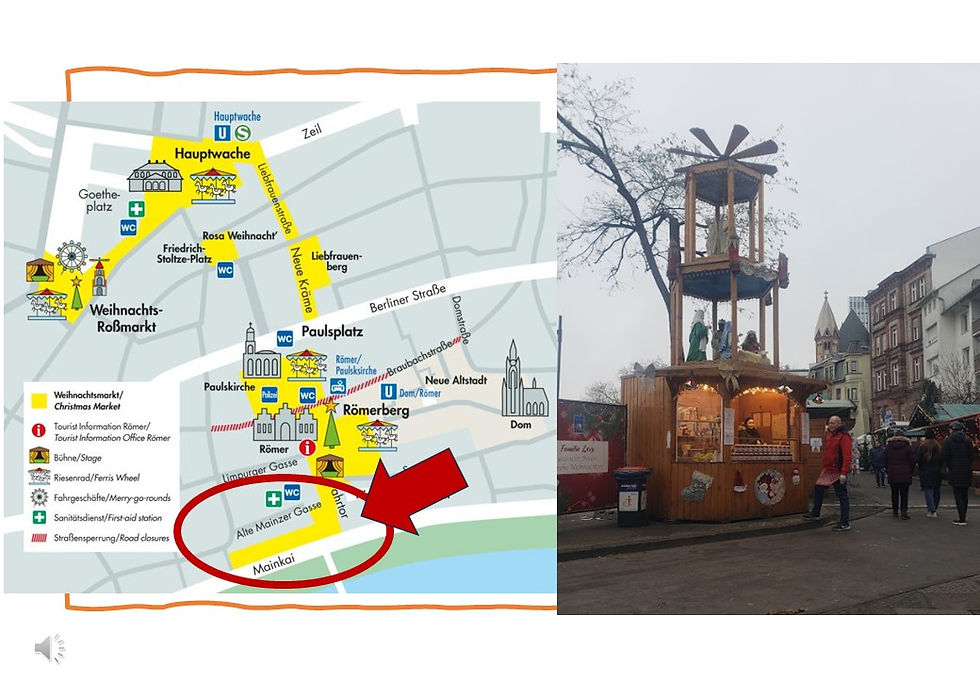


The roadblock near the Mainkai area created an extension of Weihnachtsmarkt Frankfurt Römerberg. It also blocked the access of wheelchair users. The thick rubber mat covering the road and pavement was insufficient to serve as a curb for wheelchair users.
Second, the accessibility of stalls and facilities: Christmas markets had countless selling stores and food/beverage stalls. Some stalls are accessible and approachable for wheelchair users. For example, having a wide and safe ramp at the entrance or sufficient space for wheelchair users to manoeuvre in the stall. Signages and prices of some food stalls were easy to read and placed at a reasonable height for wheelchair users.


Some stalls have a easy-to-read menu at a reasonable height for wheelchair users. Some stalls had a ramp at the entrance to be more welcoming to customers with a wheelchair, a walking aid or a pushchair.
However, some food stalls were installed with a platform without a ramp. Visitors in wheelchairs like me would not be able to read the price menu, communicate with the staff or even collect food.
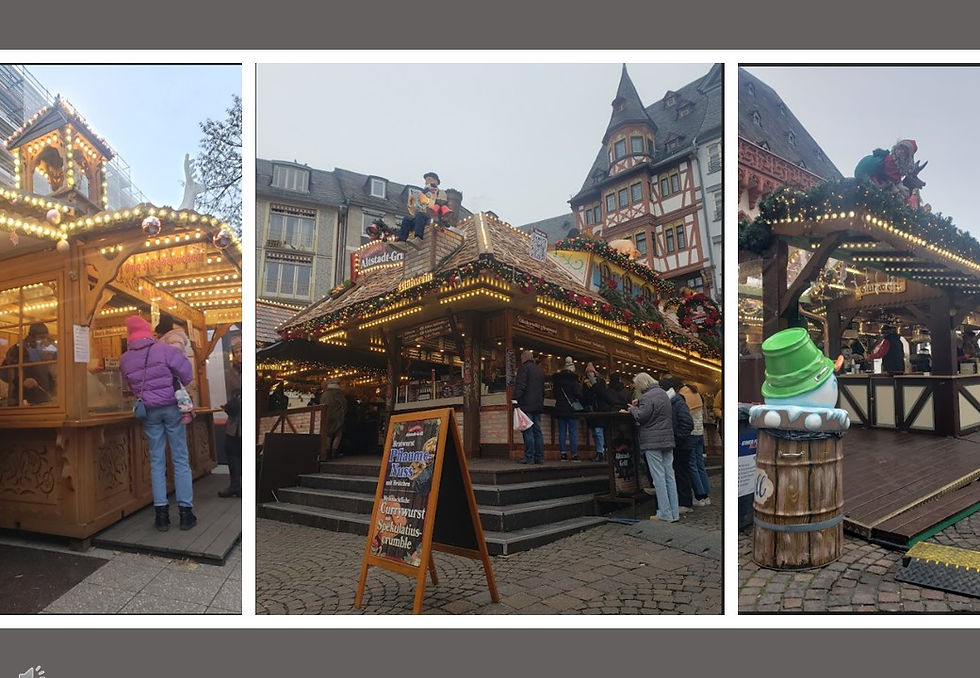
Some stalls were located on stairs which is not accessible for wheelchair users. Some stalls had a platform at the reception which created barriers for wheelchair users to take a closer look for a purchase.
Some staff were considerate and provided straws, bigger plates or napkins to accommodate my needs. However, I had to depend on my PA in some occasions, especially when I was not able to use a disposable fork or when bar tables were too high for me.
As for accessible toilets, we did not notice any signage on the accessible toilet. I found it challenging to head to the remote toilet area. I would prefer to find a well-maintained accessible toilet from museums nearby (during its opening hours). Due to my health condition, I require a hoist and a bed for toileting. I failed to find a changing place in the area. We searched online but in vain. The Changing Place Organization reported the opening of the first changing place in Germany was at the city centre of Munich in 2013. Although they targeted to build 100 changing places in Germany by 2015 (https://www.changing-places.org/news/view/changing-places-in-germany). However, it seems the plan was not fully implemented. Thus, in my previous trip in Frankfurt in May 2023, I made an enquiry on changing place to a helpful staff at the Jewish Museum. It turned out that she did not fully understand and seemed not even know what a changing place meant.
Third, the health and safety of wheelchair users. Christmas markets were extremely crowded and congested during peak hours and weekends. However, it could be comfortable and relaxing during the daytime in weekdays. I found the peak hours in Christmas markets were overcrowded and potentially risky as I could hardly identify the evacuation route or safe space for wheelchair users.
Christmas markets can be sensory overload while my five senses were overwhelmed by the bright lights and flashes, loud music and announcements. On 2nd December 2023, we were surprised by the Frankfurter Große Stadtgeläut (i.e. the town's great peal of bells). This was a valuable occasion as it only occurs four times a year when the 50 bells of Frankfurt’s 10 downtown churches ring in unison in harmony for half an hour.
Cold weather and snowing were another challenge in my field trip. Although I was aware of the cold weather and the potential of snowing, I was not fully prepared for outdoor activities and idling in the Christmas market. Due to my restricted mobility and poor sensory, I found it challenging to move with multi-layers of warm clothing. On the other hand, I realized that I had frozen bites on my fingers and feet until I took off my clothing and shoes at the hotel. When it snowed, I realized that water-proved clothing and protection of my wheelchair are crucial. I also found my wheelchair unsafe to roll on the snow or slippery surfaces as my wheels were too old to have a good grip of the role. My PA had to support me when I crossed streets or at the ramp.
On another note, I found the safety of our belongings and property was important, not only for myself as a tourist with disability; but also for my carer. In one occasion, I found a suspicious stranger standing extremely close to my PA. From my first instinct, I considered he was a pickpocket who was targeting my PA’s backpack. I stopped and watched at him until he left. I told my PA but he told me that he did not realize, especially when he was attentive to me.
Experience in Transportation
As for the travel experience in the Frankfurt Airport, I found the assistance and support service is in average to most airport in Europe and Asia. Similar to some people with reduced mobility, I am a full-time power wheelchair user. To add another layer of challenges, I travel with a mobility hoist that transfers me from bed/wheelchair, a temperature-sensitive medicine, and a breathing machine for sleep apnea. Registration for assistance and handling of my medical devices could take a long time. We had to repeat explaining and providing documents (e.g. the batteries description, specs of my wheelchair) at the check-in reception, the security control, the large baggage collection or even at the boarding gate. I consider my air travel experience in early December was comfortable and at ease as the Christmas peak was yet to come.
Another important issue is about the public transportation around Christmas markets. Christmas markets are mostly located in Römerberg, Paulsplatz, Mainkai, Hauptwache, Friedrich-Stoltze-Platz, Roßmarkt. Public transportation to Christmas Market includes U-Bahn, S-Bahn and Straßenbahn. In general, U-bahn covers the city centre of Frankfurt while S-Bahn covers the outskirts of the city centre. As for Straßenbahn, it is an overground train around the city centre of Frankfurt. The nearest stations to the Christmas markets is Dom/Römer (at U-Bahn), Hauptwache and a 5 minutes’ walk (at U-Bahn and S-Bahn), Römer/Paulskirche (at Straßenbahn). In general, these stations and public transport are barrier-free and accessible.

To access information on public transportation, the RMV website (https://www.rmv.de) provides details and updates on timetables and stations. Accessible information is mostly in German while the English version has very limited information. For instance, the search engine for a recommended route for wheelchair users is limited to the German version only. The basic search only contains two questions: 1) Search for accessible travel connections/stations; 2) Levels of restricted mobility (i.e. wheelchair user with/without an assistant, strollers and walking aids). The advanced search includes 15 questions related to the weight of you and your chair, the width and height that your wheels can overcome the gap between the carriage and platform, the maximum slope for a ramp, spaces and door of the carriage.


On our field trip, we had four trips in U-Bahn, three trips with S-Bahn and one trip with Straßenbahn. Based on our travelling experience of these trips, there is three issues that caught our attention. First, we found the station Hauptwache confusing as it is a joint station of U-bahn and S-Bahn. On one of our trips, we found the lift of the S-Bahn was out of order. We had to cross-check two different apps to confirm the accessibility status of the station. We approached the station security team but they failed to engage and suggest other access and alternative routes to our destination. We attribute this experience to a lack of disability confidence and training for staff. Thus, the rigid boundary between U-Bahn and S-Bahn creates a grey area where no one is accounted for the station.
Second, we had another “out-of-order” lift in a station where we needed to transit to another route. We sought help from the “SOS” intercom at the platform. I tried to communicate with the operator in English but in vain. My PA had to take over the communication in German. The security staff came to us in a reasonable time. They were very helpful and friendly. Their name batch indicated the language they could communicate as well.
Third, we had an accident at the station Konstablerwache. While I was leaving the train at S-Bahn, the rear wheels of my chair fell into the gap between the carriage to the platform. I did not anticipate the width and the height between them. We were very fortunate that the passengers managed to pull my wheels out of the gap timely. We further investigated the safety and accessibility of S-Bahn. We found that there is three models of these carriages. To check its accessibility, we should have checked which carriage model we were travelling before we got on board. Unlike U-bahn with a clear logo and signage for wheelchair access, we found it challenging to identify the wheelchair access at S-Bahn. The recommended wheelchair access at the platform is located differently across different carriage models and routes. Sometimes it is located in the middle of the platform while some are at the first or last carriage. This information were in German only.
Experiences with Stakeholders
To gain a better understanding and exploration of accessible tourism in Christmas, I intended to explore the resources and services in the Frankfurt tourism ecology. I identified two key stakeholders: the Museumsufer (the Museumsufer Ticket to visit 39 museums on two consecutive days.) and the Frankfurt Tourismus (Official Travel Website of Frankfurt am Main Germany). Both stakeholders promoted Christmas events and activities in Frankfurt but do not provide information on the accessibility of these events.
The Museumsufer (https://www.museumsufer.de/en/) provided a list of 29 accessible museums which are fully or largely universally accessible, being equipped with ramps, elevators, walking aids and wheelchair-accessible toilets. Some also have facilities for persons with vision or hearing impairment, or Easy Read information guides. The municipal website (www.frankfurt-inklusiv.de) lists events for disabled persons but only in German. For instance, the Museum of Modern Art offers a wide range of multi-sensory guided tours and audio descriptions of the exhibitions. However, these tours are limited to German and require registration. Information on the date and time of these tours is only available if you make enquiry via email or phone.
The Frankfurt Tourismus (https://www.frankfurt-tourismus.de/en/Frankfurt-for/Travellers-with-handicaps) also has a dedicated webpage for travellers with disability including tourist guide, transportation advice and contact services. However, these information webpages are in German only. As for the Christmas Market and events, it listed the Christmas Market programme, seats reservations for dining and bookings for Advent stroll throughout the market. However, the webpage did not provide accessibility information.
As for the communication enquiries, I made enquiries on disability and accessibility to them respectively on 19th November 2023. As for the Museumsufer, I made my enquiry via email and received detailed information and advice within 3 working days. However, I did not receive any reply when I made further enquiries. As for Frankfurt Tourismus, I submitted the enquiry via its online form, but I did not receive any reply from them.
Based on my observation and interaction with these two stakeholders, they should promote and develop accessibility in an equitable and sustainable manner. Current information and services are not fully updated and adaptable for people with (dis)ability. Thus, most information and communications were mainly in German. Despite some museums having a good practice of accessibility, these stakeholders should demonstrate how accessibility is constructed in a social model of disability and a rights-based approach.
Conclusion
Here’s three tips to my disabled peers who are interested in travelling to Frankfurt Christmas Market. First, be adventurous to the unknown. You may not know when will snow. You will not fully sure the accessibility of your train destination. You may not even know what you will get from your food/drink order. Just keep a smile to all forms of surprises. Second, be patient and familiar with some translation apps on your smartphone. Most information are German only. Therefore, having a translation app might be helpful but takes time. Third, be creative to find solutions. You may face all sorts of challenges but the key is your proactive approach to make the first step. In whole, travelling can be a wander to distraction, but it can also be a pursuit of meanings. The joy and stumbles in our journeys reflect our growth, creativity and resilience.
To conclude my tourism experience in the Frankfurt Christmas market, I could see the potential and necessity to promote this amazing wonderland to become a world-class accessible tourism destination. It requires collaboration among all stakeholders from government, organizers, and most importantly, people with disabilities and their carers. Partnership and cooperation across accessibility experts and researchers can help to make Frankfurt Christmas Market a successful, accessible and sustainable tourism destination. Christmas tourism products and services (e.g. Christmas Cruises, train tours) should be a co-production and partnership with people with disability. My travel experience is a lens of disability to see the Frankfurt Christmas Market. I find its beauty, and the challenges, and hope to make our world a better place for all.
It is amazing of what you are doing. Our hearts go out for you. Keep us posted for your endeavor.